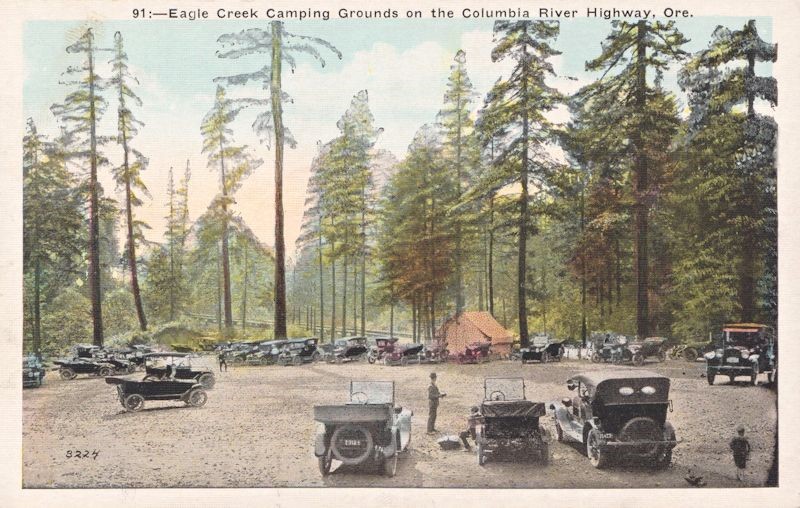
I recently had the pleasure of working at the oldest USFS developed campgound “Eagle Creek” along the Historic Columbia River Highway in Oregon. Prior to development of the Oregon Forest Reserve under the Organic Act of 1897 people were recreating in the Columbia Gorge, already considered one of the most spectacular scenic area in the Northwest, and easily accessible by rail or steamboat. The Columbia River Highway (CRH) was constructed between 1913 to 1922 as a scenic highway modeled on European roads that was designed and constructed to provide motorists with the opportunity to see up-close the landscape’s natural beauty of the Gorge.
Originally a major fishing grounds and tribal headquarters of the Cascade Indians, the “Cascades” in the Columbia River was a major obstacle for westward migration to the Willamette Valley, as noted by Lewis and Clark in 1805. This spot in the river had larger boulders making it necessary for a long portage around the river (Franzwa 1972: 372). After several years of immigrants traveling west over the Oregon Trail only to get stuck at the Cascades, a portage road was eventually built in 1854 to help assist the immigrants pass this treacherous spot; it would become the site of the first railroad in Oregon. Many pioneers documented the hazards of the river route and use of the Portage Road (Nesmith 1906; Beal 1914).
The Eagle Creek Campground is located at the site of precontact a Cascade Indian fishing camp on the eastside of Eagle Creek at the conjunction with the Columbia River, and is also adjacent to the Eagle Creek Overlook which has a view of Bradford Island which was the location of a historic Indian massacre (1855 and 1856) and is one of the few spots in the region that was involved in the Indian Wars (Bryant et al 1978.)
The Columbia River Highway (CRH) historically passed through this area providing access to the campground and the other nearby recreation activities. This scenic highways was designed and constructed to provide motorists with the opportunity to see up-close the landscape’s natural beauty. Constructed from 1913 to 1922, the CRH predates all other scenic highways in the United States, and was a major was a technical and civic achievement of its time, attracting many local and tourists to the Columbia River Gorge The segment of the CRH from Corbett to Eagle Creek, in east Multnomah County, had been completed by late 1914 but the bridges, viaducts, and masonry work lagged behind. The Historic Eagle Creek Bridge was completed in 1915 officially opening up the Eagle Creek Campground and Picnic area to the public (Hadlow 2000).
In 1983, the Eagle Creek Campground and Recreation areas was identified in the Columbia River Highway Historic District National Register evaluation of the Columbia River Highway in 1983, the author wrote:
“Two recreation areas in Mount Hood National Forest at Eagle Creek are included in the historic district because of their historical connection with the highway. Eagle Creek Campground and Picnic Area is south of the old highway route and the present fish hatchery. The campsite and 13.5-mile Eagle Creek Trail were established in 1915. The campground is considered the first Forest Service campground in the United States. Its success, facilitated by the construction of the Columbia River Highway, led to the development of other similar sites around the country. The early development included camp tables, toilets, a trail check-in station, and ranger station.
“In the 1930s, the campground was expanded and improved by the Civilian Conservation Corps (CCC). A picnic area was added in 1936-37 by the CCC, with stone water faucets, stoves, and retaining walls. Restrooms and shelters were built in the “rustic style,” using peeled logs, board-and-batten siding, cedar shake roofs and native stone. A unique feature of the park is the 175-foot suspension bridge at the south end of the recreation site across Eagle Creek. This bridge (1936) connects the picnic area with the Shady Glen Trail.
Although the campground and picnic area have been improved since the original dates of construction, they still retain the construction integrity and workmanship of the CCC period. The campground has 18 tent sites and 5 trailer sites around a loop road. The picnic area has approximately 70 picnic tables.
The park contains about 40 picnic tables, 17 stone fireplaces and 11 stone water faucets. An extant small portion of the old Columbia River Highway is located in the overlook park and serves as a parking lot. The two national forest areas contain a total of about 48 acres (1983:22).
In 2000, the Historic Columbia River Highway was listed as a National Historic Landmark District and the CCC constructed Big John Public Comfort Station was listed as a contributing building to the eligibility of the district as well as the CCC constructed low masonry walls and walkways in the Eagle Creek Campground and Recreation Area (Hadlow 2000).
In 1915, the Oregon National Forest (by 1924 the Mount Hood National Forest) established the first improved forest campground in the United States near Eagle Creek, south and east of the CRH, as the Eagle Creek Forest Camp. It included day-use picnic facilities, good water, and sanitary conveniences. By the 1930s, the Civilian Conservation Corps (CCC) had greatly enlarged the Eagle Creek Campground, constructing several major buildings. From 1915 to 1937, a privately owned campground northeast of the bridge rented cabins with attached garages. A two-story lodge offered home cooking, fishing supplies, and groceries. The Cascade Salmon hatchery was constructed on this site in the 1950s. A suspension bridge constructed over Eagle Creek in 1936 to provide access to the Eagle Creek Trail was destroyed in a winter storm in 1996.
The Eagle Creek Campground is east of Eagle Creek and south of the original CRH alignment at this location. All structures there date from the CCC era and include a Community Kitchen, a Public Comfort Station, and a Registry Booth generally located along a campground loop road. Low stone walls line the road. Stoves, water fountains, tables, and stairways are all part of the CCC construction at the campground. Another loop road continues beyond the Registry Booth and climbs the hillside to several more recent drive-in camp spots.
The Eagle Creek Overlook is north of the Eagle Creek Campground. It is located on a point high above the Columbia River and north of Interstate 84. This area provides a group camping or picnicking and originally offered premium views of Bonneville Dam’s construction. The Eagle Creek Overlook Building provides shelter from group picnics. A masonry retaining wall runs the length of the bluff in front of the building (2000:36). The Eagle Creek Campground is included within the Columbia River Highway National Historic Landmark District. The Eagle Creek Public Comfort Station (Big John) is listed as a contributing building to the NHLD.
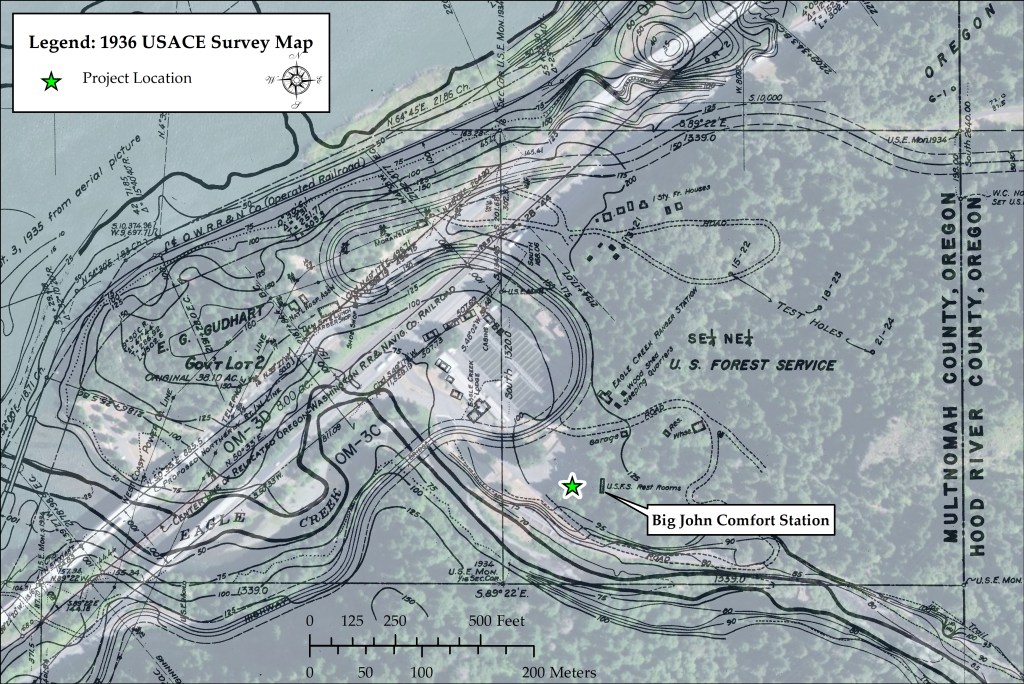
Here is a map I created for the “Big John Comfort Station” overlaying a 1936 historical survey map – beyond Bonneville Dam Backwater pool in 1938 there has been alot of changes over the course of 85 years. #history #preservation
Bibliography:
Beal, J., 1914, Manuscript #1508, in Oregon Historical Quarterly, Portland Oregon
Bryant, Richard, Leslie Conton, Robert E. Hurlbett, and John R. Nelson, 1978, Cultural Resource Overview: Mt. Hood National Forest, Oregon Volume I, Pro-Lysts, Inc., Eugene Oregon
Franzwa, G.M. 1972, The Oregon Trail Revisited, The Patrice Press, St. Louis, MO.
Hadlow, Robert, 2000, National Historic Landmark Nomination for the Columbia River Highway. Designated as NHL on January 3, 2001.
Nesmith, J.W., 1906, Diary of the Emigration of 1843 in Oregon Historical Quarterly 7(Dec.):92-359.
Smith, Dwight A.,1983, Nomination National Register of Historic Places, Historic Columbia River Highway.
 Abbott Cultural Heritage Preservation