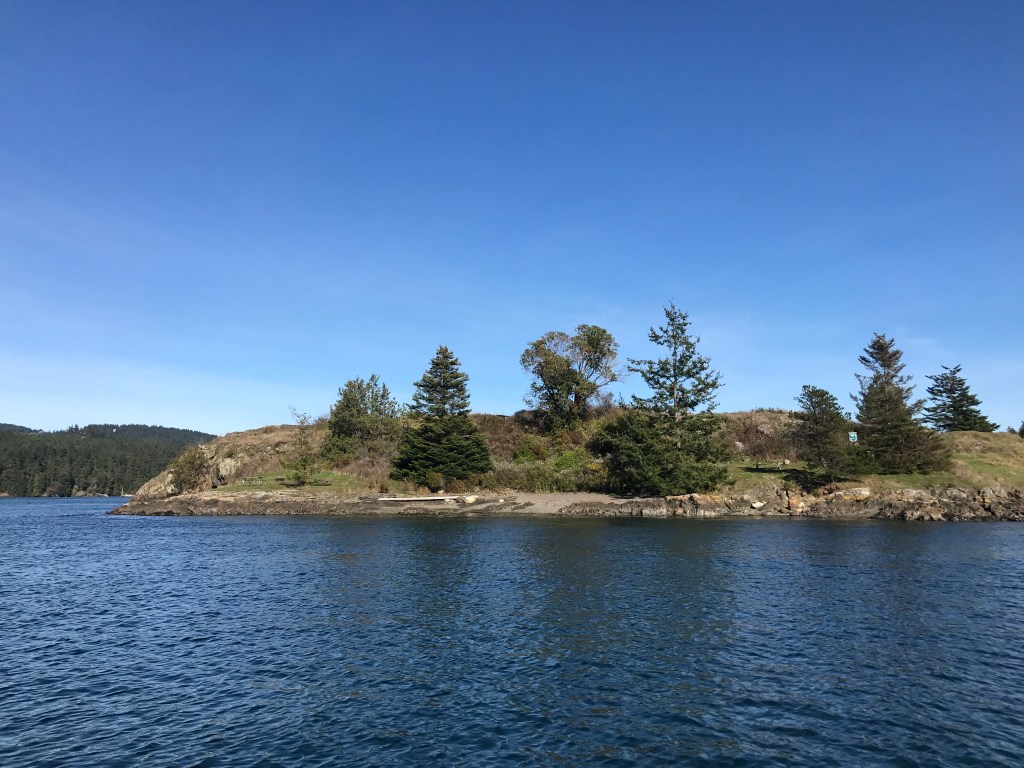
Fox/Lindholm Residence
Historic background research conducted found that the original semi-permenant occupants of Blind Island in the historic era were two German immigrants, Johannes Sievert Fock (i.e. John Fox Sr) and his brother Simon of Bellingham, Washington. It appears from the historical records that the brothers first discovered Blind Island in the early 1900s while harvesting and selling dogfish livers for oil. Dog fish were abundant in the San Juan Islands, especially in the areas of Blind Bay and West Sound. The production of dogfish oil was vital to the early Pacific Northwest lumbering industry, primarily to grease skid roads as well as lubricate machinery, and was also used for tanning hides for sawmill belts and was a superior substitute for whale oil for lamps, despite its strong odor. Beginning in the 1850s, the industry initially employed coastal tribes who used land lines or nets, but the growing demand and abundant fishery encouraged Chinese and Euromericans to also fish for dogfish livers. By 1880 petroleum products began to replace fish oil as did the introduction of carbon -arc lights. The peak year for price was 1890, Geodosh notes
Despite the inroads of technology, the fish oil industry still existed in 1890. During that year, according to the state fish commissioner, 50,000 gallons of oil were produced, and two hundred men were engaged in “catching fish from the livers of which a fair quantity of oil” was manufactured. Two years later, the value of fish oil products dropped to $14,000, down $2,500 1890. Oil extraction is not mentioned in the annual reports which were issued by the state fish commissioner after 1892, possibly because there was little or no production (Gedosch 1968).
An oral interview with Eric Lindholm Jr, grandson of John Fox Sr, established that John Sr had tried to file a homestead patent for Blind Island and another patent for the tidelands, but he was declined both times due to measurement inaccuracies (Lindholm 2019). In the early 1900s John Sr and his brother Simon proceeded to build a cabin on Blind Island which was pirated away by another brother while John and Simon were fishing in Alaska. The house was floated on logs to the head of the Bay and was sold to a local resident. That structure was incorporated into a small bungalow on the Blind Bay waterfront cove on the east side of the Bay which became the Deane property (Lindholm 2019). The house was demolished and replaced by a guesthouse by the Deane’s on the same footprint around 2004.
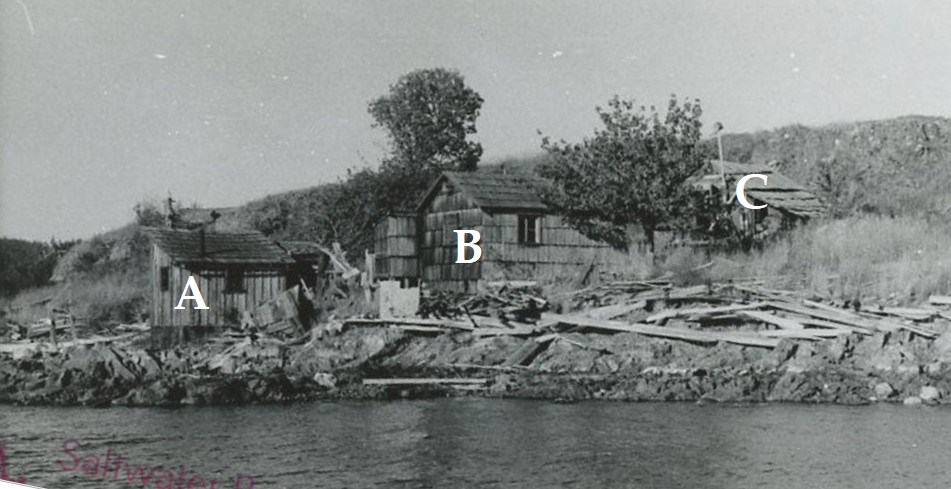
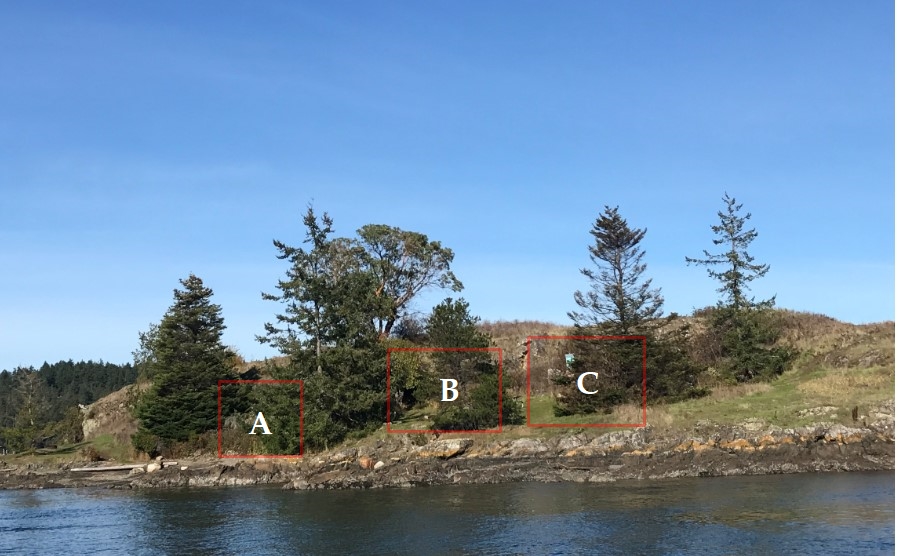
After John Sr. returned to find his house gone, he built the two cabins (one for himself and one for his daughter Emma and son in law Eric Lindholm, as well as a fishing shack and the large cement cistern on the south end. The Blind Island residents would otherwise supplement their fresh water needs by towing a scow to Orcas to get water (Lindholm 2019).
The Lindholm’s lived on Blind Island for several years; Eric and Emma’s fourth daughter, Marie, was born on Blind Island January 26th, 1916, delivered by Eric during a harsh snow storm when the islands were reported to have received over 28 inches of snow. They tried to leave the island when her labor began but didn’t want to chance a stormy crossing to Orcas in their small rowboat. After Marie was born, Emma and Eric moved to a cabin above the Orcas Hotel overlooking Blind Island and raised a large family, and stayed very much involved with her Blind Island family, especially her brother John Jr. Emma would out-live Eric by twenty years and pass away on March 6th, 1975 in Whatcom County, Washington (WSA 1975).
John Sr, had a son also named John. John Jr. would participate in WWII and like many of his generation was adversely affected by the harshness of war and would never marry, and he is said to have been a quiet, eccentric man after his war duty. After the war John Jr lived for a while with his father in Seattle where he worked for the US Government as a surveyor before resigning to live a solitary life on Blind Island near his siter Emma. John Fox Sr. died September 2nd, 1934 at the age of 83 and was buried on Blind Island.
John Fox Jr. was characterized by his grandnephew as a “sourdough” just like his father, preferring fishing and the solitude of Blind Island so much so that he was termed the Hermit of Blind Island. He treasured his sister Emma and her large family, often visiting her on Orcas Island via his “leaky old rowboat”. He remained on Blind Island until the mid-1960s when he was moved to a nursing home. He was reported to have been in the Veterans Hospital in 1965 and died in Oak Harbor, Washington on October 18th, 1971 (WSA 1971). His family spread his ashes over the top of his beloved Blind Island (Lindholm 2019).
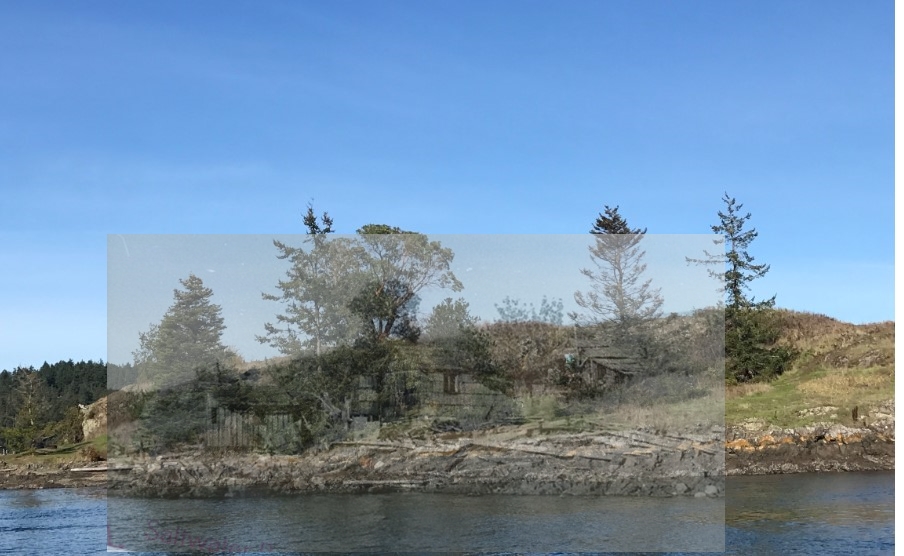
After John Fox Sr. left the Island, the buildings were removed and Blind Island today is administered by the BLM and leased by Washington State Parks.
Bibliography
Gedosch, Thomas F., 1968, A Note on the Dogfish History of Washington Territory. The Pacific Northwest Quarterly, Vol. 59, No. 2 (April 1968), pp. 100-102, University of Washington.
Lindholm, Eric, 2019, Oral Interview Blind Island and Fox Family by Genavie Thomas, August 7, 2019.
Washington State Archives (WSA), 1909, Washington, Marriage Records, 1854-2013, Marriage Record for Emma J Fox and Eric Wilhelm Lindstrom, Washington State Archives Olympia, Washington: 1971, State Death Record Index for John S. Fox, 1940-1996. Microfilm. Washington State Archives, Olympia, Washington: 1975, State Death Record Index for Emma Lindholm, 1940-1996. Microfilm. Washington State Archives, Olympia, Washington.
 Abbott Cultural Heritage Preservation